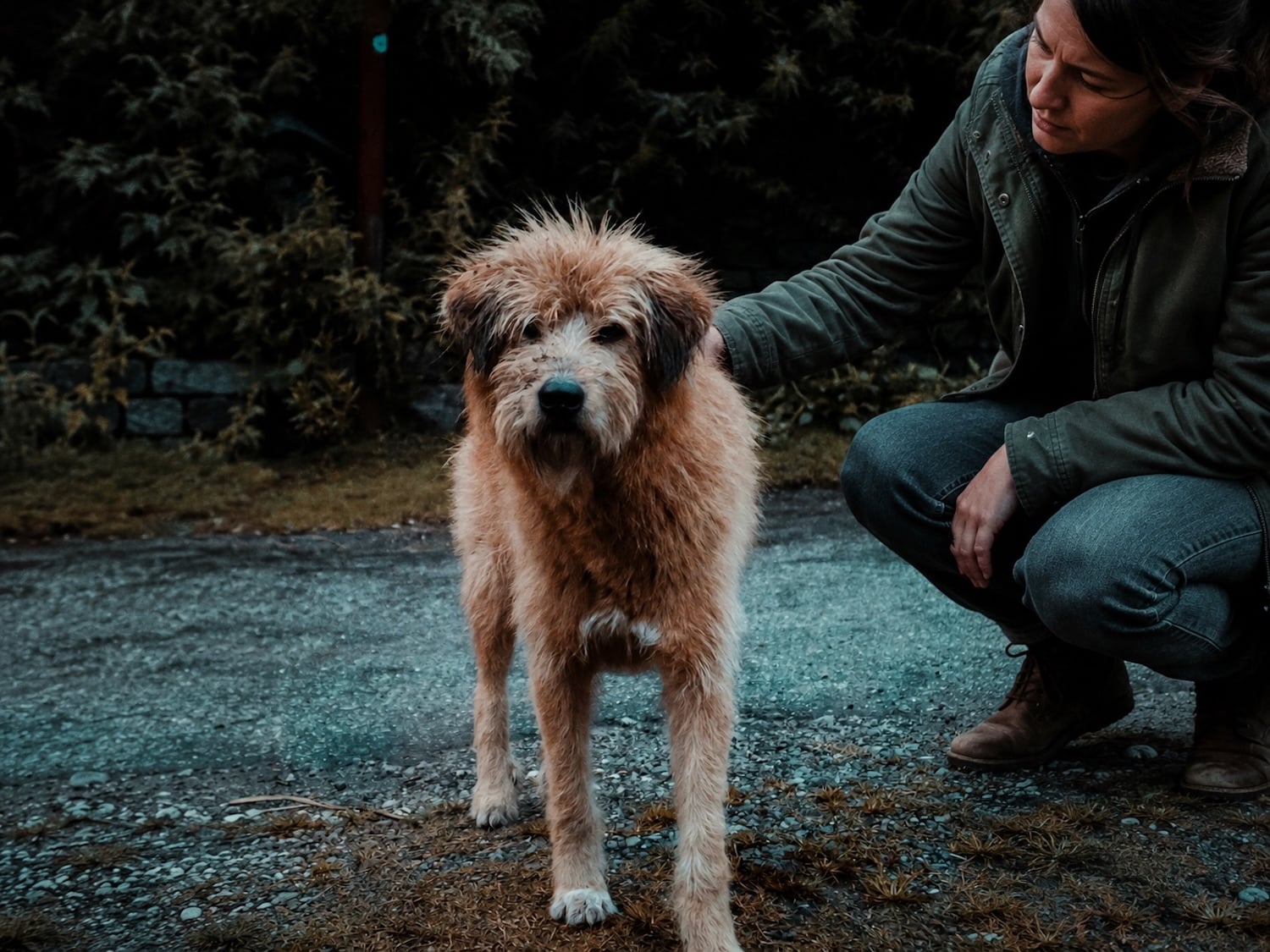
You notice the back end first. The thighs that used to be solid feel thinner under your hand, the hips a little sharper, the back legs not driving the way they once did. Some mornings they slip on the floorboards, or wobble for a second when your dog rises from a nap.
So you mention it, to a friend or at the dog park or even at the vet. And what comes back is some version of the same sentence: he’s just getting old.
It isn’t wrong, exactly. Old dogs do lose muscle, and yours is old. But notice what the sentence does: it closes the conversation. Underneath the kindness sits something harder to argue with, a quiet nothing to be done, just age, best to accept it. And once you accept that, you stop asking the question you actually wanted answered, which was never whether your dog is ageing. It was whether there’s anything useful, kind, and realistic to do about what you’re seeing.
“Just getting old” is an observation. It isn’t a plan.
You can hold both at once: age is part of the picture, and there’s still something worth doing about it. That’s not denial, and it’s not panic-buying everything with “senior” on the label either. It’s the steadier middle ground. From there, a few honest questions: what muscle loss in senior dogs actually is, how to tell ordinary ageing from something that needs a closer look, and which of the things people suggest (more protein, exercise, supplements, even a weighted vest someone mentioned) are actually worth your time. Some of them are. Some of them aren’t. And in a couple of cases, the honest answer is that nobody really knows yet.
What’s actually happening when an old dog loses muscle
There’s a name for the age-related version of this: sarcopenia. It’s the slow loss of muscle mass and strength that comes with age in an otherwise healthy dog, not from disease. It starts earlier than most people expect, often around seven or eight, and large and giant breeds sooner than small ones. If your dog is eight and you’re already seeing it, you haven’t missed a window or done something wrong.
A younger dog’s body builds and replaces muscle efficiently. An older dog’s does it less well, so the same food does less and the same activity holds less, and muscle slips away unless something pushes back.
The scale can lie to you here. A dog can hold exactly the same weight, or even look a little heavy, while real muscle vanishes under a layer of fat. That’s why “he’s eating fine and his weight’s steady” isn’t the reassurance it sounds like: weight and condition are different things.
Age-related loss is slow and roughly even on both sides, thinning over months. It isn’t the fast, dramatic wasting of a dog who’s genuinely sick, and it isn’t one leg gone thin because a sore joint has stopped your dog using it. Those are different stories with different endings, which is why the first real question isn’t “what do I feed him.”
First, the question that actually matters: is this age, or something else?
One question should always come first, and it’s the one that’s easiest to skip: are you sure this is just age?
Because sometimes it isn’t. Sometimes what looks like an old dog losing condition is the first sign of something with a name and, often, a treatment: lymphoma, kidney disease, Cushing’s, an underactive thyroid, a neurological problem in the back legs. Ageing is not a diagnosis by itself. That doesn’t mean panicking at every grey hair, though. It’s the same steady attention either way: not waving the change away, and not fearing the worst, just looking properly before you decide what it is.
Ruling things out can feel like overkill, so it helps to remember the position you’re in: you’re the advocate for someone who can’t tell you what’s wrong. Your dog can’t say “my back leg’s been weak on one side” or “I feel sick, not just old.” Ruling things out is crude, but when the patient can’t speak, it’s often the only honest way in, and most owners grasp that the moment it’s named. It’s the same instinct that makes you watch a too-quiet toddler more carefully, not less.
Rather than a list of conditions to memorise, here’s what would make you stop assuming this is ordinary ageing. The signs sort into three kinds, and they point in different directions.
One is a dog who seems unwell rather than just older: loss that’s fast rather than gradual, off their food, drinking and weeing much more than usual, flat in themselves. That points at something systemic.
Another is loss that’s one-sided, or that comes with the back end giving way: one leg clearly thinner than the other, toes that scuff and drag, back feet that knuckle over, a hind end that crosses and stumbles. The painless, dragging version of this can be early degenerative myelopathy, a spinal-cord disease, and the absence of pain is exactly what makes owners miss it.
The third is pain itself: yelping when touched, a hunched back, flinching when handled.
And running underneath all of them, the one owners raise again and again: eating well but still losing. That’s a flag, not a comfort.
Settle for “just old age,” though, and you miss the real point: a normal ageing change still deserves a plan. Ruling things out isn’t about expecting a disaster. Either you catch something treatable early, or you get genuine reassurance that this is age, and can get on with managing it well. If you do only one thing with everything here, make it this check: it’s the line between guessing and knowing, and most of the time the news is the reassuring kind.
This is also what taking your observations to the vet looks like. Ask for a hands-on muscle check, not just a weigh-in, because the scale misses muscle hidden under fat: there’s a standard, free way vets score it, called a muscle condition score, and you can learn to feel the same landmarks at home. Ask them to check for pain. And if anything points to disease, one detail is worth carrying into the appointment. In a dog who’s lost muscle, the standard kidney number (creatinine) can read falsely reassuring: it partly reflects muscle mass, and there’s less muscle now to produce it. A marker called SDMA isn’t thrown off the same way. You don’t need the biochemistry, just the question: “given he’s lost muscle, should we look at SDMA, not just creatinine?” That’s the kind of thing that makes a vet treat you as a partner.
If it is age: what to do, and where to start
By now the treatable diseases are ruled out or being managed, and pain is absent or handled. What’s left is age-related loss, and now the question is what’s worth doing.
There’s an order, and it matters: feed, move, support, roughly in that sequence, because that’s roughly the order of how much evidence and return sits behind each. It isn’t a menu to pick from; it’s a sequence to work through, and the early ones matter more than the late ones. The weighted vest someone may have mentioned gets a look too, not as a step but as a worked example of how to weigh a suggestion. And once you’ve given something a fair go, there’s the final task: checking whether it’s working, which has a section of its own.
One thing to hold onto, because it shapes how you read all of this: every choice on the list has a cost as well as a payoff, in money, time, and the consistency that’s genuinely hard to sustain. Each one below comes with an honest read of what it asks of you, not just whether it works. This isn’t a protocol you’ve failed if you don’t finish it. The point of naming each cost isn’t to judge you; it’s so you can choose what’s actually doable.
Feed: protein, and the myth worth unlearning
For a healthy senior dog, the old advice to cut back on protein is backwards. Older dogs generally need more good-quality protein to hold muscle, not less, because the ageing body uses it less efficiently, and it now takes more protein to maintain what a younger dog held on less.
The myth is worth naming, because it isn’t owner ignorance, it’s handed-down wisdom that got stuck. The “go easy on protein for old dogs” idea traces back to laboratory studies on rats, decades ago, where high protein did stress ageing kidneys. But rats and dogs differ on exactly this point. The finding got carried across anyway, and it’s been quietly costing old dogs muscle ever since.
But “just pile on protein” would mislead you, because quality matters too, and so does the phosphorus that rides along with high-protein foods. A well-formulated food with carefully balanced protein can hold muscle better than one that simply runs a higher percentage but is built less thoughtfully. The takeaway isn’t “buy the highest-protein food on the shelf,” it’s “good-quality protein, not restricted, and worth a proper conversation rather than a number on a bag.” One real exception needs naming here, not buried: if your dog has diagnosed kidney disease, the lever isn’t protein, it’s phosphorus, and it’s a vet-guided conversation that depends on the stage.
The cost here is mostly attention. It’s the cheapest, highest-return change on the list, which is why it’s first.
Move: the right kind, not just more
If feeding has the clearest answer, movement arguably does the most, provided it’s the right movement. The instinct on reading “exercise helps” is to walk your dog more, and that isn’t what this means.
The goal isn’t distance, it’s strength and function: the muscle that holds your dog up, lets them rise, gets them into the car. A long plod doesn’t build that; gentle, deliberate work that asks the muscles to do something does. And short and frequent beats one big outing, because the dog who’s quiet all week and then does a huge Sunday walk is the one most likely to get hurt. What that work actually looks like: slow sit-to-stands (a dog’s version of a squat), walking over low obstacles so each leg lifts deliberately, a gentle incline, weight-shifting. Smaller, targeted movements rather than more flat walking. (The exact move-by-move routine is a whole topic of its own, beyond what we can fit here.)
The genuinely well-supported option, if you can access it, is hydrotherapy, usually an underwater treadmill. The buoyancy takes the load off painful joints, so a sore or weak dog can move and build muscle without the impact that would otherwise stop them, and studies document real improvement at any age. The honest caveats: it costs money, needs a facility near you, and some dogs hate the water, in which case the stress isn’t worth it.
But more movement is not universally good. A dog with significant arthritis, disc disease, or a neurological condition needs a different, often much gentler or professionally guided approach, and the wrong loading harms. Pain comes first too, because a dog in pain can’t build muscle: pain relief isn’t separate from the exercise plan, it’s what makes it possible. For arthritis that’s traditionally meant anti-inflammatories (NSAIDs), which work but can be hard on an old dog’s stomach, liver, and kidneys. A newer option is a monthly injection (bedinvetmab, sold as Librela) that blocks a pain-signalling protein instead, useful for the older dogs who can’t tolerate long-term NSAIDs. If your dog seems sore, that conversation comes before the exercise, not after.
The cost here is effort and consistency, plus money and logistics for hydrotherapy. But of everything on this list, deliberate movement is the thing most likely to hold your dog’s muscle, which is why it comes so early.
Support: supplements, sorted by what they’re actually for
This is where honest evaluation matters most, because the marketing is loudest and the desperation highest. The useful move isn’t a product list, it’s a single question you bring to every supplement: what problem is this meant to solve, what’s the actual evidence, what does it cost, and what would count as it working?
Start with the one marketed hardest for canine muscle loss: Fortetropin, sold as Myos. It does have real published studies. But they’re funded by the manufacturer, and in the main published trial in senior dogs, the dogs taking it didn’t clearly do better than dogs on a placebo matched for protein and fat. That’s the tell: against a similar amount of ordinary protein and fat, the special ingredient seems to add little. It doesn’t mean the owner who said “it helped my old boy” is foolish; something probably did help. It’s just that the something was most likely the protein, which you can get more cheaply elsewhere. The supplement with the more objective evidence isn’t the loud one. It’s HMB, a compound the body makes from the amino acid leucine, studied with scans and muscle sampling rather than owner questionnaires. The data is still thin for ordinary ageing dogs, and some of the firmer findings come from other muscle-wasting conditions, but it’s better-grounded than the louder product’s, and the volume of the marketing tells you nothing about the strength of the evidence.
The rest are simpler. Omega-3s (fish oil) are a fair, evidence-backed yes, working mostly by easing inflammation and joint discomfort, which protects muscle indirectly by keeping your dog moving. Joint supplements (green-lipped mussel, glucosamine and chondroitin, collagen) help muscle only indirectly too, one step removed by easing joints so the dog moves more. Green-lipped mussel has the best evidence of them, but don’t let a joint supplement masquerade as a muscle treatment. And creatine is one to skip for an ordinary ageing dog: it can push that same kidney number (creatinine) up and muddy the blood work, for no muscle benefit shown in old dogs.
Most of our readers are in Australia, and that changes the practical picture. The two supplements actually aimed at muscle, Fortetropin and HMB, are the two you basically can’t buy here through normal channels. Neither sits on Australian clinic shelves or in local pet pharmacies. To get them, owners are forced into international orders and grey-market listings. Meanwhile the supplements that are everywhere in Australia, properly regulated as animal feed products under the APVMA, are the joint ones, the ones that help muscle only indirectly. Availability and the evidence line up here: what’s aimed at muscle you can’t readily get, and what you can get easily is really for joints. The shelf an Australian owner can reach is a comfort shelf, not a muscle-building one, which is one more reason feeding and movement come first.
And there’s a real catch before anyone orders a vial from overseas: these are animal-derived products, which the Department of Agriculture treats as a high biosecurity risk, so importing them needs permits and non-compliant shipments can be seized at the border. As for why they’re missing here, that’s worth being honest about: whether it’s regulatory hurdles or simply no distributor finding it worth registering them, nobody really knows. The fact is solid, the reason isn’t, and it’s more honest to leave it there than to invent one.
Supplements are add-ons, not the main event. The honest spend is on what comes before this.
A worked example: the weighted vest
And then there’s the idea of strapping weight onto the dog: a vest, ankle cuffs, a loaded pack. It earns a mention not because it’s mainstream (it isn’t; it lives in sport, conditioning, and seller marketing) but because following the thread teaches you how to think about all of this. Someone joined a sensible dot: if weight training builds muscle in people, why not put some weight on the dog? It’s half-right, and the key is to separate the idea from the delivery.
The idea, that bearing weight builds muscle, is sound, settled biology: working a muscle against resistance breaks it down slightly and rebuilds it stronger in the rest between sessions, as true for a dog as for a person at the gym. The delivery is where it falls down. A vest sits over your dog’s spine and shifts weight forward onto the front legs, but dogs already carry around 60 per cent of their weight on the front, and the problem you’re fixing is usually in the back legs. A vest loads the wrong end. The rehab world, wanting the same effect, uses small weighted cuffs placed low on the target leg, under guidance, which tells you the instinct is sound enough that professionals act on it. But those cuffs have been studied mostly for recovery after surgery and correcting how a dog walks, not as a proven way to rebuild muscle in an ordinary ageing dog.
Our read: it’s genuinely unsettled, both ways. Too early to say a weighted approach works for an ageing pet dog, too early to say it doesn’t, and the better-targeted cuff isn’t established for this either. The answer isn’t “buy a vest” or “don’t,” it’s “talk to a rehabilitation vet about targeted, supervised loading,” not a solo experiment with something off a website. One part isn’t unsettled, though: for a dog with diagnosed disc disease or significant arthritis, added load of any kind is off the table, because weight on a compromised spine or painful joints does real harm. The person who suggested it had a reasonable instinct and was right about the mechanism. The open question was never the logic, it was the delivery.
Review: how you’ll know if any of it is working
Whatever you choose, one thing or several, you need a way to tell whether it’s working. A plan you can’t measure is just hope with a schedule, and the things worth watching are things you can see from your own kitchen.
Is your dog steadier? That’s the headline: rising more easily, slipping less, managing the stairs or the jump into the car better than a month ago. A few habits make the trend easier to see. Run your hands over the same muscle every few weeks, so you’re feeling change rather than guessing. Watch the weight trend, but read it alongside condition, never instead of it. And film a short phone video from the same angle every few weeks, because day to day your eyes adjust to slow change and miss it, while a video a month apart shows what you couldn’t feel.
Then give it a fair window, measured in weeks and months, not days, and judge honestly. Keep what’s earning its place; be willing to stop what isn’t. That’s not giving up, it’s the same attentiveness that started this, pointed now at your own efforts instead of your dog’s symptoms. You observed, you acted, now you check, and you take what you find back to the vet.
You probably won’t do all of this. That’s okay.
There’s an enormous distance between knowing all of this and actually doing it, and most people never cross it, including the ones who love their dogs most and have read all the way to here. Most articles won’t admit that. A piece that hands you the full programme and assumes you’ll run all of it is lying about how this actually goes, and the reasons aren’t excuses. The supplements cost money you may not have spare. The rehab and home exercises are real, ongoing effort. The vet check keeps getting put off. And there’s a quieter reason nobody says out loud: the dog still looks happy. Still wagging, still eating, still pleased to see you. That read is often not wrong.
Knowing what you could do is not the same as doing it, and doing less than the full list doesn’t make you a bad owner. The internet’s fantasy is that information equals action, that once you know, you’ll naturally do. Real life doesn’t work that way, and the gap isn’t a moral failing. It’s human, and nearly universal.
Which is the real reason any of this is worth knowing. Knowing all this has value even if you act on almost none of it, because it changes what you’re watching for. If your dog stops looking happy, if the decline tips from “older” into “something’s wrong,” you’ll notice sooner and know what you’re seeing. The payoff was never “go do all of it.” It’s “now you can think about it clearly, choose what’s feasible, and watch honestly.”
“Just getting old” was never a good enough answer, and neither is doing everything, forever, regardless of what it costs you or your dog. Most age-related muscle loss won’t fully reverse, and it’s honest to say so rather than sell false hope. But the realistic minimum is small and real: one vet check to rule out the treatable things, then watching with informed eyes. If that’s genuinely all you do, you’ve still done the thing that mattered most. And the same attention works in the other direction too. There comes a point with some dogs where the kindest thing is knowing when not to push for one more intervention, when the next thing on the list is really more for you than for them. Quality of life is part of looking after a dog, especially an old one.
The honest next step is the smallest one: the muscle check with your vet, your observations in hand. After that, the rest is yours to weigh, not a protocol you’ve failed if you don’t finish it. And if your dog is only just crossing into their senior years, it’s worth understanding what’s ahead more broadly.
Your dog can’t tell you what they need. But you noticed their back legs changing, and you didn’t let “it’s just age” be the whole answer. That was the hard part.