You know the sound. The heavy panting after a walk that should have been easy. The snoring that rattles through the house at night. The laboured breathing on a warm afternoon that makes visitors ask if your dog is okay, while you explain that “no, really, she’s always like this.”
Maybe she is always like this. That’s part of the problem.
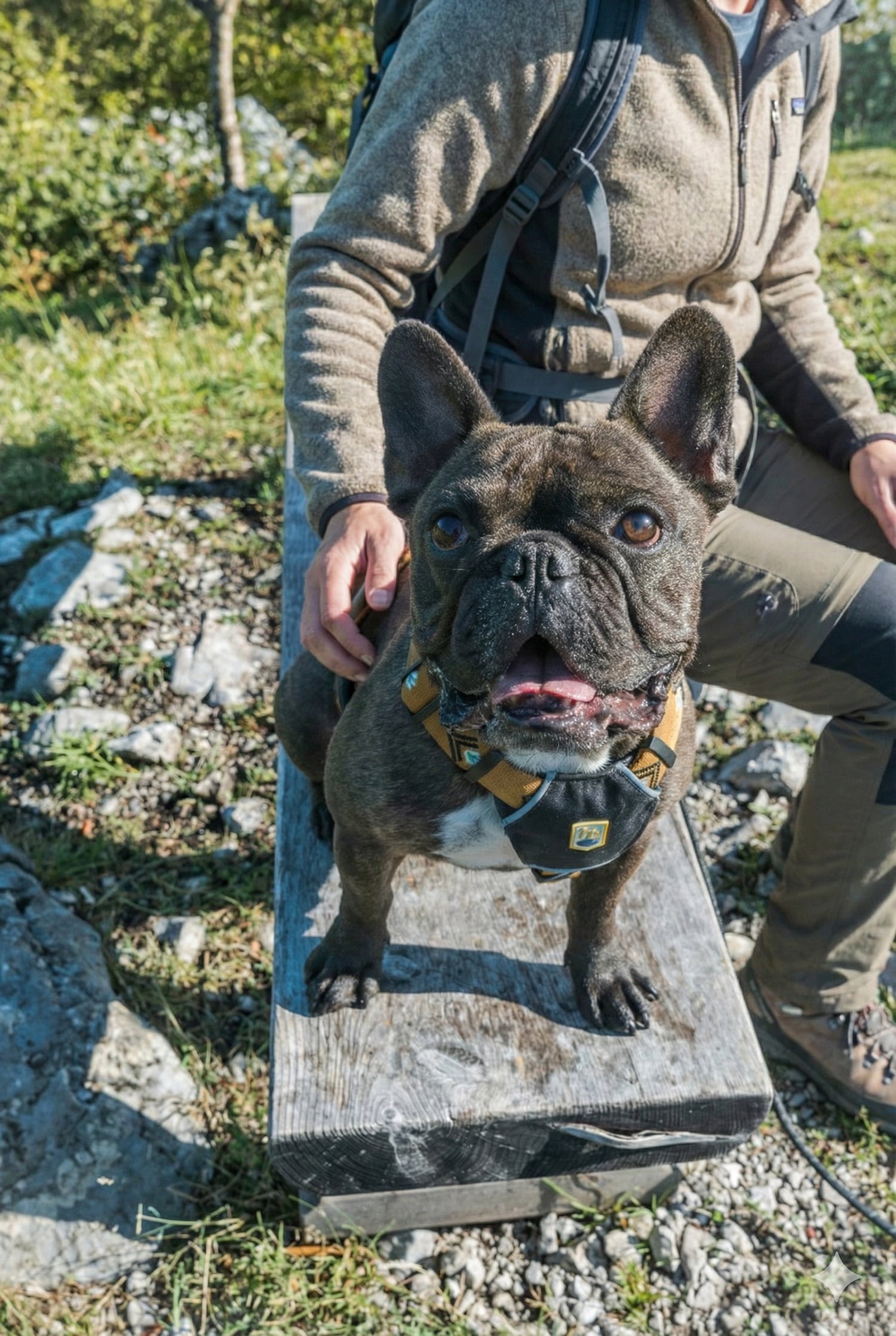
If you own a French Bulldog, Pug, English Bulldog, or any flat-faced breed, you already know heat is a concern. What most owners don’t know is why their dog is at risk, how serious it really is, and at what point “normal for my dog” crosses into something that needs action. And if you’ve stopped searching because most of what’s out there comes with judgement about your breed choice, this isn’t that.
Why Panting Doesn’t Work the Way You’d Expect
Dogs cool themselves by panting. Air moves over moist membranes in the airways, evaporates, and pulls heat away from the body. They barely sweat, so panting is nearly the whole system.
In flat-faced dogs, that system is compromised. The shortened skull means narrowed nostrils, a soft palate that’s too long and partially blocks the airway, and often a windpipe narrower than it should be. Each of these restrictions reduces the volume of air that can move through, which means less evaporation, which means less cooling. (If you’ve come across the term brachycephalic or BOAS in your reading, this is what it describes.)
But it’s worse than just being less efficient. The effort of forcing air through those narrowed passages generates its own heat. In a Labrador or a Kelpie, panting is a net positive: the cooling far outweighs the effort. In a flat-faced dog, the maths can reverse. The harder they work to cool down, the more heat they produce. It becomes a feedback loop, and it’s why these breeds can go from “warm but fine” to genuine emergency faster than anyone expects.
28 Degrees Is the Line, and Humidity Pushes It Lower
Veterinary research puts the high-risk threshold for flat-faced breeds at 28°C. That’s your upper limit. Above that, your dog’s compromised airways can no longer keep up with the body’s cooling demands, and Australian summers routinely exceed it.
But temperature alone doesn’t capture the full picture.
Evaporative cooling only works when moisture can actually evaporate into the air. On a humid day, the air is already saturated. Your dog’s panting moves air through the airways, but almost nothing evaporates. They’re doing the work of cooling without the result. A 24°C afternoon in Brisbane at 80% humidity can put a flat-faced dog under real pressure, because the system that’s supposed to protect them barely functions in saturated air.
This is why coastal and subtropical regions need earlier caution than the thermometer alone suggests. If you live somewhere with summer humidity, 28°C is not your starting point for concern. It’s already past it. Start watching your dog’s breathing at lower temperatures and adjust from there.
The Panting You’ve Accepted as Normal
Many flat-faced dog owners have quietly recalibrated what “normal” breathing looks like. The snoring and snorting, the heavy panting after minimal exertion: when your dog has always sounded like this, it fades into background. You stop hearing it the way visitors do. And when your dog seems happy and comfortable otherwise, there’s no obvious reason to question it.
Some of that breathing genuinely is breed-typical. But breed-typical and healthy aren’t the same thing. Research shows that many owners view heavy panting and noisy breathing as cute personality quirks rather than signs of airway obstruction. The snoring that sounds endearing may be a dog struggling to keep their airway open during sleep. The panting that “always” follows a short walk may be a dog whose cooling system has never worked properly.
That can be a hard thing to sit with when you’ve spent years telling people your dog is fine.
You didn’t miss something obvious. These signs are genuinely hard to read when they’ve been present since puppyhood, and when most of what’s written about your breed reads like a case for never owning one, there’s not much reason to look closer. But knowing what to watch for changes what you can catch.
Your dog’s resting breathing rate is the place to start. Count the breaths for 15 seconds while they’re calm and asleep, then multiply by four. That number becomes your per-minute baseline, the thing you compare against on a hot afternoon when the panting looks heavier than usual.
Recovery time after moderate activity matters too. If panting hasn’t settled within five to 10 minutes in a cool environment, that’s a signal, not a quirk.
And listen to the sounds themselves. If the pitch or volume of your dog’s breathing has shifted, or if they’re visibly working harder to breathe than they used to, that’s information you need to act on.
What to Do with What You Now Know
If your dog is panting frantically, vomiting, or going weak or unresponsive, you’re looking at a potential emergency. Move them to shade or air conditioning and start applying cool water to their belly, groin, and paws. Not ice, just cool water, and a fan if you have one.
Their gums tell you where things stand. Healthy pink means keep cooling. Bright red means heat stress is underway and you need to act faster. Blue or purple means circulation is failing and you need a vet now. Call ahead so the clinic is ready.
Cool first, transport second. The duration of overheating determines the outcome more than anything that happens at the clinic.
That’s the emergency. The rest of summer is about making sure you never need those steps.
Air conditioning is the most effective tool you have during Australian summers. If you don’t have it, you can still manage well: fans in a tiled room, a shallow wading pool, a damp towel on a cool surface. What matters is moving the air and giving your dog somewhere cool to rest. Walk early morning or after dark, and test the pavement with the back of your hand for seven seconds before your dog steps on it. If you can’t hold it there, it’s too hot for paw pads.
Restricting outdoor activity doesn’t mean your dog sits in a dark room for four months. Scatter feeding, puzzle toys, and scent work can tire your dog’s brain without putting their body at risk. A slow sniff-walk in the cool of early morning, where your dog leads and you follow their nose, can be more satisfying than a midday march and completely safe. Indoor training sessions build engagement without heat exposure. Your dog needs mental stimulation, not kilometres.
Living with a Flat-Faced Dog in the Heat
The next time someone asks if your dog is okay, you won’t need to explain it away. You’ll know what you’re listening for, and whether what you’re hearing has changed.
This week, count your dog’s resting breathing rate while they sleep. Write that number down, and bring it to your next vet visit. Ask whether your dog’s breathing warrants further assessment. Find your nearest 24-hour emergency vet and save the number. Keep cool water and towels accessible during summer.
You’ve spent years explaining your dog’s breathing to other people. Now you know how to read it yourself.